
One in Nine. That’s the number of people who can passably read musical notation at even a basic level, according to deep research that we spent 30 seconds on. These are the band nerds, the choir kids, the church worship leaders. And fortunately, a few Disney songwriters.
For everyone else, musical notation is an inscrutable system of strange glyphs on graph paper. Staccato dots explode across the page — some half filled in, others with random flags at the top. You might as well be looking at Morse code, Braille, or an old-timey computer punch card. It’s a nightmarish flashback to taking the SATs or voting for President in Florida. Did they use a Number 2 pencil to fill this in? Did I accidentally just vote for the Green Party?
But sheet music is a language — full of rhythm, pitch, timing, and weird Italian instructions that tell you when to get very loud (fortissimo!) or very soft (pianissimo!). And for the lucky 11% of the population who can speak this language (or rather, sing it), Disney has hidden coded messages all over the theme parks just waiting to be discovered.
Here are some of our favorites
Mickey’s PhilharMagic
This one had to make the list, right? The whole idea of Mickey’s PhilharMagic is that you are watching an enchanted orchestra, taking you on a whirlwind tour through some of Disney’s most enduring musical classics. And at least one dud from the Lion King.
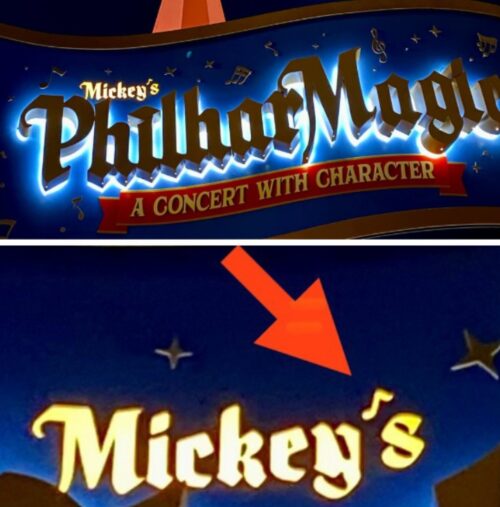
You can barely move around the theater without stepping on music references. The official logo for the attraction even uses an eighth-note as an apostrophe.
But the most fun example of secret musical notation occurs in the Fantasy Faire gift shop. Even though it’s not hidden, most guests never see it, for one simple reason: you have to look up.
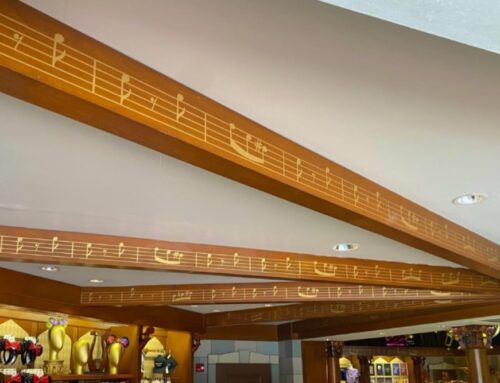
On the ceiling beams, a piece of music plays out in gold lettering. If you’re a normal person, it looks like simple decoration, in a shop already filled with a dozen musical instruments and an irritated duck. But if you’re a musician, you can hum along to it.
Before you know it, you’re humming the theme song to one of Mickey Mouse’s most iconic roles: The Sorcerer’s Apprentice, from Fantasia. Yeah, it’s the part with the brooms.
The Buena Vista Street Starbucks
You weren’t expecting that one right? I didn’t call it by its official name, because even most Disney fans don’t have a clue. But if you must know, it’s the Fiddler, Fifer, & Practical Cafe. It is the de regueur Starbucks location at Disney California Adventure.
The Disney wiki for this restaurant gives a backstory about the Silver Lake Sisters (professionally known as Fiddler, Fifer, and Practical), who opened this establishment on Buena Vista Street. And it saddens me that most Disney fans — and even most Cast Members — are more apt to know this backstory than the real reason for the Cafe’s name. I speak from firsthand experience.
Flashback to many, many years ago. A young, idealistic Parkeologist has just been hired at Walt Disney World to work as an attractions host at Big Thunder Mountain. During the new hire orientation known as Disney Traditions, the facilitator of the class asks if anyone knows the real names of the Three Little Pigs, from Walt Disney’s 1933 Silly Symphony cartoon. My hand shoots up. It is the only one. And it was then that I realized that I had possibly overdone it with the arcane Disney knowledge.
In case you need it spelled out, Fiddler Pig, Fifer Pig, and Practical Pig are the official names of the Three Little Pigs. Makes a lot more sense as pigs than as hot young all-female bandmates.
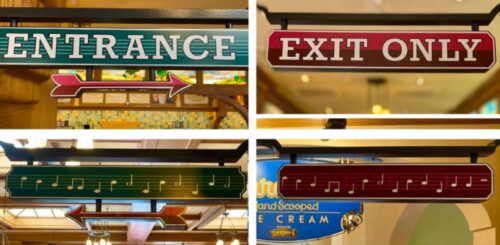
Our favorite Three Little Pigs reference in the Starbucks almost escapes unnoticed. You have to be looking at the backs of the Entrance and Exit signs when you go to order your coffee. But if you do — and if you understand musical notation — you may discover one of Walt Disney’s earliest and most popular Great Depression-era songs.
Rock ‘n’ Roller Coaster Starring the Muppets
You’d expect more musical notation from another music-themed attraction on the list. There are a hundred Muppet easter eggs on the ride. This one is easy to miss. It’s in the parking garage area where you board the ride. And it’s tucked all the way across the other side of the roller coaster load zone, in an area only Cast Members can patrol.
You’ll see a chalkboard probably used by Dr. Bunsen Honeydew to decipher the physics of roller coasters. Most of the board is taken up by inscrutable mathematical equations. But music and math are not all that dissimilar! A phrase of sheet music clearly appears in one quadrant of the chalkboard.
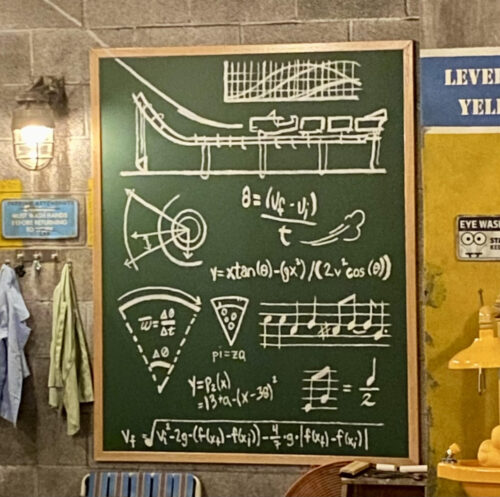
The Muppets are no stranger to iconic songs. Is this Rainbow Connection? It’s Not Easy Being Green? No, it’s the opening line to the song that started it all.
“It’s time to play the music…”
Any child of the 70s knows the theme song to the Muppet Show!
The Undeciphered Musical Notation
We’re throwing another Rock ‘n’ Roller Coaster reference in here as a bonus, because this musical notation came and went without anyone ever figuring it out.
It could be that it was truly just a random jumble of notes and rests, created by one of those 89-percent-ers. You know, the ones who have no idea how music works. But yet, it seemed so intentional. A long-lost secret waiting to be discovered.
We confess, we spent way to much time trying to decipher this. And now that the Muppets have replaced Aerosmith on the ride, this particular piece of sheet music has been removed.
It was a mere door handle, of all things. A piece of etched metal that functioned as a push/pull bar on the entrance to G-Force Records.
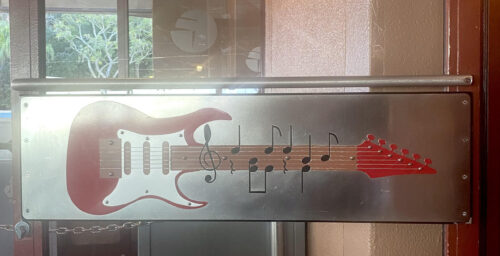
As a clever design motif, it does a good job of transforming the strings of the guitar into the staff of sheet music. Then it goes completely off the rails.
- Sheet music has 5 lines, not the six lines of the guitar strings.
- Two “rest” symbols appear below notes. In real musical notation, they would take the place of a note.
- Some of the notes appear to straddle multiple lines, when they should be directly on a line, or directly between two lines.
- The rhythm is all out of whack. If you played this out on a guitar or piano, it would sound like the song cut off in the middle.
And then there are the notes themselves, which are discordant even if you mapped them to the guitar string notes or to the corresponding notes of sheet music.
The best we could ever come up with, by assuming that the rests come after the notes above them, is that it almost sounds like part of the classic guitar riff for Smoke on the Water, released in 1973 by Deep Purple. That would fit the classic rock theme of the original Rock ‘n’ Roller Coaster. But it’s a real stretch (ha ha, make it a super stretch.)
When the Muppets moved in, this bit of door handle mystery disappeared for good. An explanation (if one ever existed) may never be found. But if you happen to have a theory, please let us know in the comments!


The bounty of posts lately.
It’s like won the lottery or something
But can we keep it up? time will tell…
Not sure if it’s still there, but the lobby at the Port Orleans French Quarter has the notes for “When the Saints Go Marching In” near the check-in desk.
That’s an excellent one! It has been awhile since I was at the Port Orleans lobby, but now that you mention it, I do remember this!
(Probably bad) theory about the last one: it looks like music written for two different parts/instruments on the same staff. The upper notes and rests are the melody and the lowers are the rhythm. The style looks familiar from playing handbells, but I suspect in this case it’s supposed to be a lead guitar and a rhythm/bass guitar?