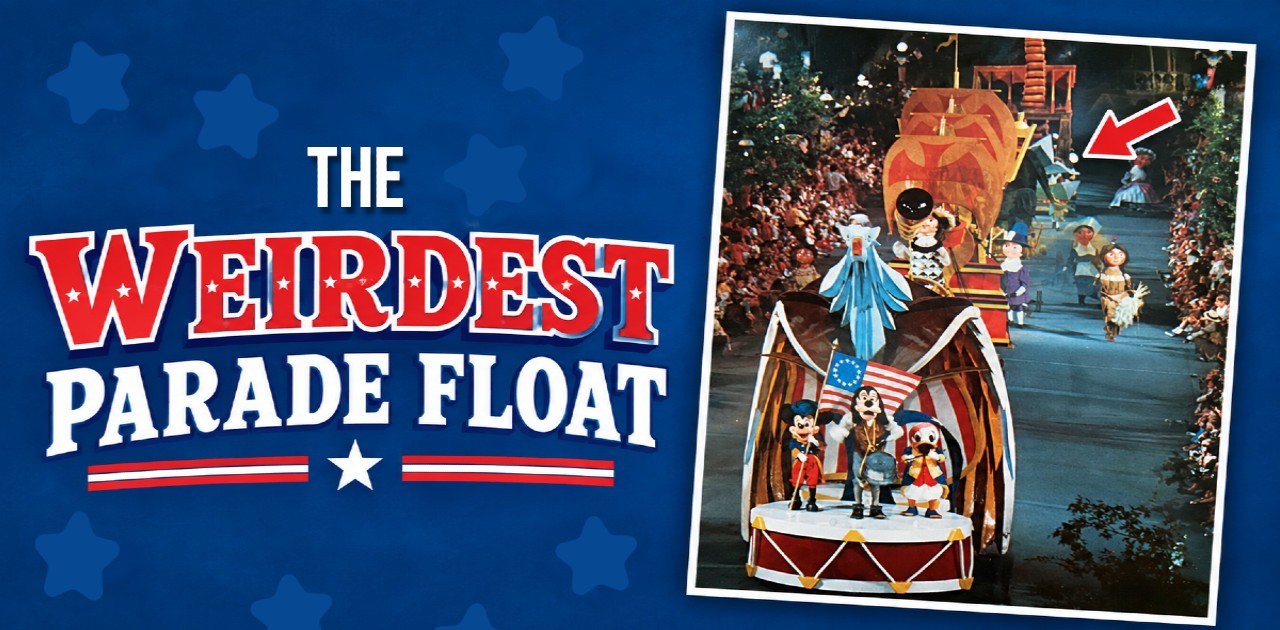
In 1976, in a rare display of theme park coordination and synergy, Walt Disney World in Florida and Disneyland in California decided to celebrate America’s bicentennial with a year-long parade.
They created the Noah’s Ark of parade floats. Two of everything. One for the East Coast, one for the West. It was a parade to memorialize the founding of the good old U.S. of A. It was so good, they ran it first in the daytime, and then again at night.
They called it America on Parade.
Okay, yeah, it was weird by modern standards. Few actual Disney characters were to be found. And those that appeared are total unknowns to most Disney fans today. The neon-furred members of Scat Cat’s jazz band. Bongo and Lulubelle the circus bears. A multiverse version of Pocahontas, with an oversized head.
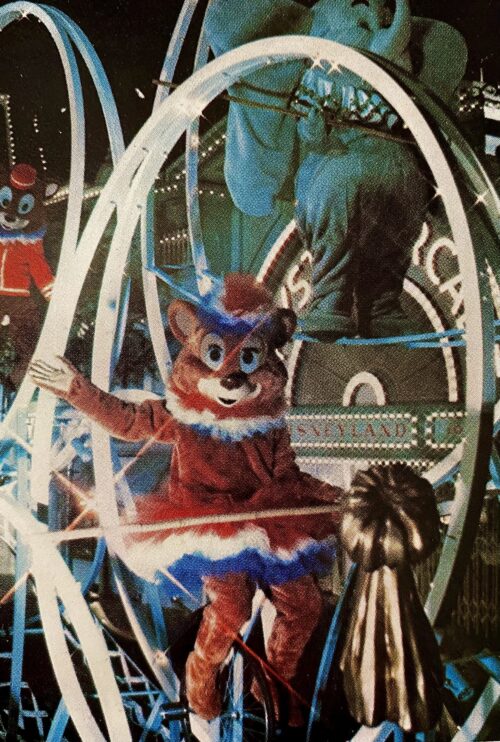
Whole histories have been written about the oversized head creatures. The People of America, with their towering stature and uncanny valley, baby doll heads. They filled every nook and cranny of America on Parade. And when the celebration finally ended, they migrated to Epcot to creep out guests in World Showcase.
But Disney never intended them to be creepy. The Big Heads represented America as viewed through the eyes of a child. Disney’s own literature calls them a “family” (forgetting that even Leatherface from the Texas Chainsaw Massacre had a family). The America on Parade floats and people were simply larger than life. In the words of an official Disney promotional booklet:
The purpose is to present the lighter, more beautiful aspects of America, those things which have helped make it a great nation.
So of course, they included one parade float with an oversized scene of barbaric torture and drowning of unruly women.
You know. Just the high points of history.
Finding the Weird Parade Float
Here at Parkeology, we are old enough to have seen America on Parade. But not necessarily old enough to remember it. I do recall seeing Mickey, Goofy, and Donald carrying that Spirit of ’76 flag on the parade float at the start of the parade. But I’m not sure if it’s a real memory, or if it came from watching home movies shot by my parents.
All other knowledge of the parade has come from what we’ve picked up over the years studying the parks. And we’re not big parade people to begin with. We prefer the rides and immersive environments. But curiosity often leads down the parade rabbit hole.
We’ve written many times about watching old park videos. We always lament how the cameraman never shows us the stuff we’re interested in. Film was a precious commodity. And most of what interested these original theme park auteurs were … the parades.
So we’ve seen them. They’re the bits of the video you have to suffer through before the cameraman finally makes it onto Jungle Cruise or explores the outside of Space Mountain. America on Parade appeared only 4 short years after the opening of Walt Disney World. That makes it one of the first park touchstones to vanish. It was long gone before camcorders took over. 8mm movie film was the best you were going to get.
The iconography of the parade quickly became familiar. Betsy Ross sewing a flag in a giant rocking chair. Lady Liberty with her torch. A steamboat captain piloting a huge parade float of Southern belles and gentlemen. A towering Dagwood-style sandwich that I guess represented America’s love of gluttony.
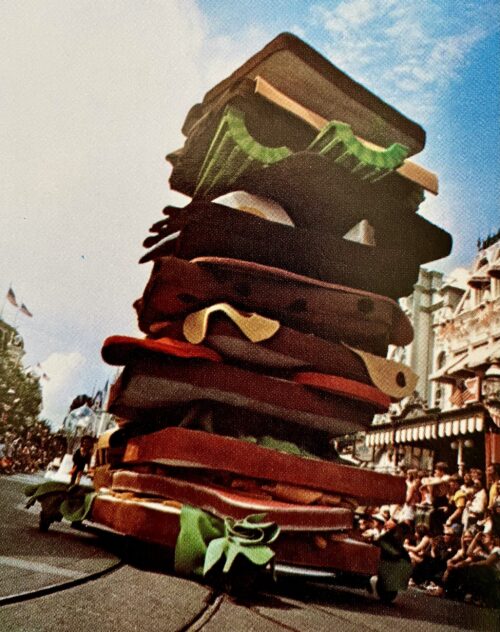
But one strange parade float kept popping up amidst all the rest. Never commented on, never lingered upon. It was just sort of there, somewhere in between Christopher Columbus on his sailing ship and the Revolutionary War soldiers carrying the Liberty Bell.
It was a parade float seemingly made of wood. At its front, the governor had locked some poor colonist in the stocks. That’s weird enough in itself, but not uncommon at the Magic Kingdom. Liberty Square still has its own picture-worthy platform to recreate public punishment from the 1700s (You might call it a stock photo. Get it?)
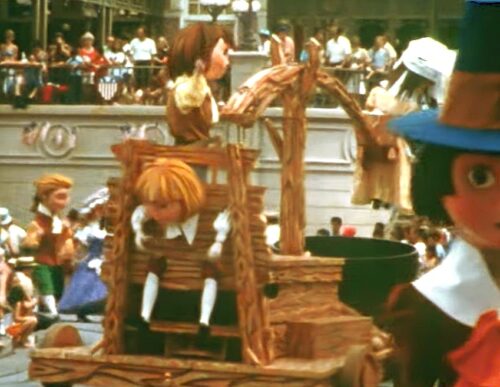
But that’s nothing compared to what’s going on at the back of the parade float. Here we see a poor pilgrim woman strapped into a wooden stool, suspended from a huge wooden crane, hovering over an iron kettle while some dead-eyed Big Head works the lever.
In grainy 8mm footage on YouTube, it’s virtually impossible to figure out what is going on here. Especially viewed a few seconds at a time. The camera operators seem to have a subconscious understanding that they shouldn’t be filming this. It’s an uncomfortable gnawing in the pit of their stomach. After all, Disney sprung this parade float on them by surprise. One minute it’s Donald Duck playing the fife. The next, it’s a panicked woman with her arms tied down.
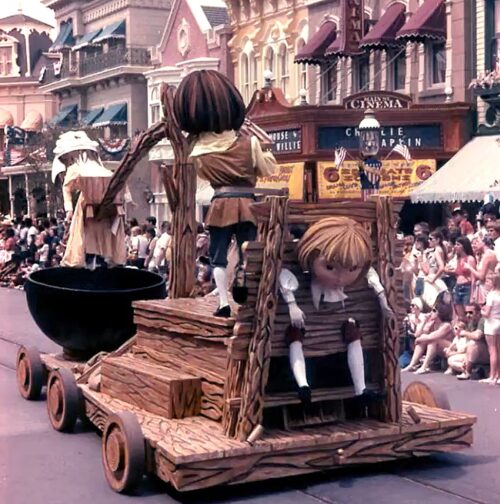
We admit, when we first saw it, we thought the woman was just seasoning a large stew in that giant crockpot for her “family” to eat later. I mean, so far the darkest moment in America on Parade has been that giant 20-foot tall turkey being led on a leash by a bunch of pilgrims. Maybe this is just a continuing celebration of the first Thanksgiving.
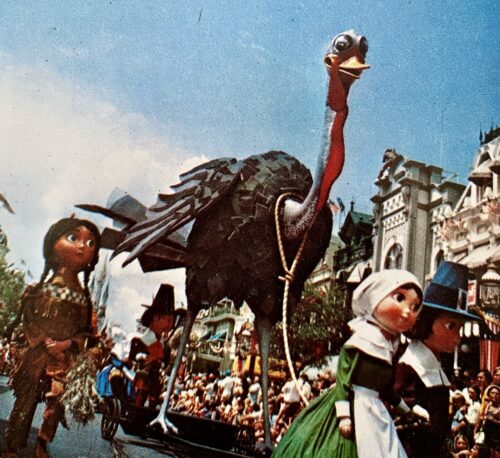
It is only by catching new glimpses through different parade videos — a new angle here, a long shot there — that you realize what is going on.
This poor Big Head is being slowly tortured to death.
The Fine Art of Witch Ducking
Honestly, for most of our lives, we thought the pseudo-science of identifying witches was just a silly movie joke. No basis in real history. In a famous scene from 1975’s Monty Python and the Holy Grail, Sir Bedevere the Wise educates a group of ignorant peasants on how to weigh a suspected woman against a duck. If they weigh the same, then the woman must be…
A witch!
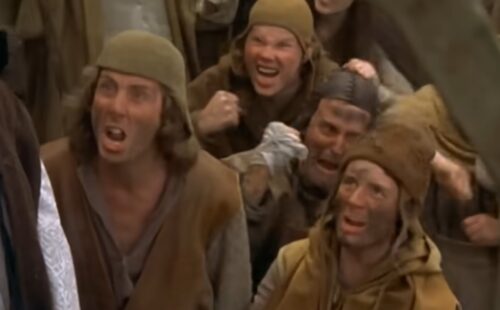
It was such a ridiculous rationale in the movie, we assumed the Pythons completely made it up. And it was only much later (possibly while researching this post) that we learned that ancient people really did believe that pure water would reject the devil’s servants. The practice of “witch ducking” was a real thing. Put the hapless woman in a pond. If she sinks (and, uh, drowns), she was a-okay. But if she floated back up…
A witch!
Later (or perhaps at the same time), another practice popped up called the Cucking Stool. This was basically the same thing as Witch Ducking, but in this case, the woman was just a common scold who dared to pop off in front of her neighbors. The goal here was not witch-identification, but a form of public punishment. They would fasten the woman to a wooden stool or chair, then repeatedly dunk her in the water. Sometimes she died, but hey, maybe stop scolding people.
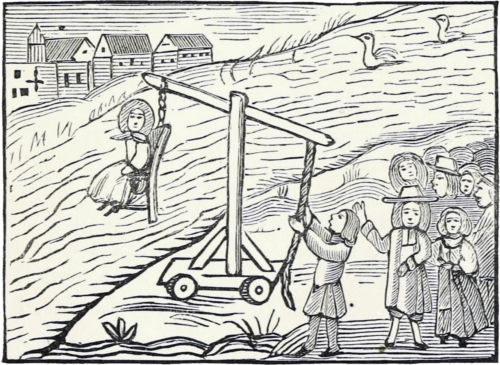
It’s not totally clear if the America on Parade float is celebrating witch ducking or cucking stools. You might read about Christopher Columbus or Ben Franklin in history books, but not so much about the public humiliation, torture, and drowning of women. Yes, the Salem Witch Trials were a thing. Yet I don’t recall much discussion about strapping an arm chair to a crane and dangling women into a vat of whatever toxic liquid that kettle is supposed to be holding.
However, we are proud to report that witch ducking and cucking stools were finally made illegal in 1844 by the State of New Jersey. Sometimes it’s the small victories that count.
Even Disney Didn’t Like to Talk About the Ducking Parade Float
Walt Disney Productions produced a short 4-minute extended advertisement for America on Parade. They thought it was something worth celebrating. It starts with the obligatory Spirit of ’76 float and progresses through the highlights of the parade.
First comes Christopher Columbus and his spyglass. We think maybe we’re going to speed-run the whole show. But no. It conveniently skips right over the turkey slaughtering and the cucking stool on its way to more fun discussion about Benjamin Franklin.
Here at the Parkeology offices, we happen to own a vintage booklet released by Disney in 1975. It is titled America on Parade: A Salute… A Celebration at Disneyland and Walt Disney World. It is indeed a mouthful of a title. It’s a 22-page full-color salute to all nations but mostly America.
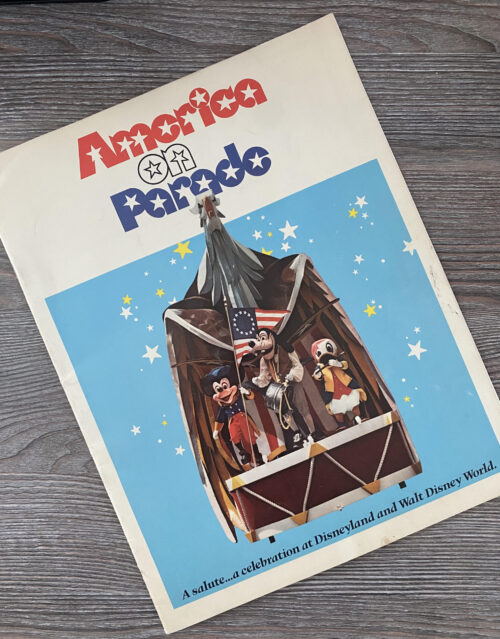
It trumpets all aspects of the parade. The book talks about its impact:
From the first sights and sounds of the parade to the grand finale, there are moments when you’ll laugh, smile, and maybe even shed a tear of joy in recalling a memory of times gone by.
It talks about its importance:
Because of Disney’s vast experience and expertise in producing entertainments on a grand scale, it was very fitting… that Walt Disney’s company take a leading role in using Disneyland and Walt Disney World as a showcase for the best that America has been and has to offer.
It even talks about how it lured unsuspecting high school students to suffer under the weight of giant plastic heads:
These participants, generally 15 to 17 years of age, receive one unit of credit for each nine-week session, along with hourly pay.
Throughout the book, every parade float is featured with a glossy publicity shot or a tantalizing behind-the-scenes look at its manufacture. Every parade float except one, that is.
The Witch Ducking float is neither mentioned nor shown. Not even in the background of another action-packed view of America on Parade as it works its way down Main Street, U.S.A.
Disney, it seems, had just the tiniest bit of reticence in calling any attention to its inexplicable monument to public humiliation and torture.
In fairness, it should be noted that there is an even larger book about America on Parade. It was released around the same time as the paperback version. And it did briefly reference the Ducking float.
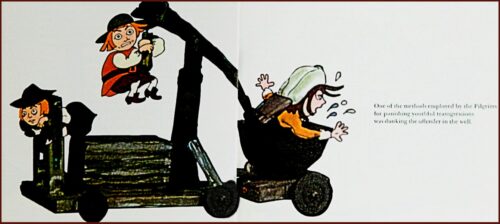
Ah, you see? Nothing wrong with a little public dunking for those unruly youths. This isn’t a cucking stool. That woman is not a witch. She’s just a teen who got a little too sassy. Sure, let’s include it in our parade celebrating American history.
Listen, we get that social awareness changes over time. Multinational corporations are a lot more sensitive about what they depict in mass entertainment these days. America on Parade debuted only a few years after Pirates of the Caribbean, with its infamous Red Head scene. We can expect some out-of-touch moments.
But this is truly a weird one. Pirates of the Caribbean is one thing. A pirate’s callous disregard for women may be despicable, but at least it is a well-known trope within pirate stories. And that particular story takes place in a spooky, darkened show building full of cannonfire, skeletons, and out-of-control arson. Bad behavior is kinda the norm.
At the American Adventure in Epcot, Disney famously wrestled with how much of the dark side of history to include. They wanted the show to be uplifting, but also not a total sanitization. That show was always poignant, serious-minded, and trying to treat its subject matter with the utmost respect. Even still, people debate whether they got it right.
Parades, however, are different. By Disney’s own words, America on Parade was meant to have:
A special visual, animated, theatrical, and audio impact so that every person viewing it would be totally caught up in the excitement … The goal was to have guests go away with the feeling that they had really “celebrated the Fourth of July.”
I don’t know about the rest of you, but my family doesn’t usually celebrate Independence Day with some ballpark franks and a little good old-fashioned witch ducking.
It’s just an absolute bananas topic to base an entire parade float around. No basis in any specific historical American event. Especially when the witch in question is staring out pleadingly at the parade audience with glassy eyes, from a skull the size of a beanbag chair.
You can understand why Disney didn’t like to feature it in the promo materials. But why in the world did they decide to put it in the parade in the first place?